
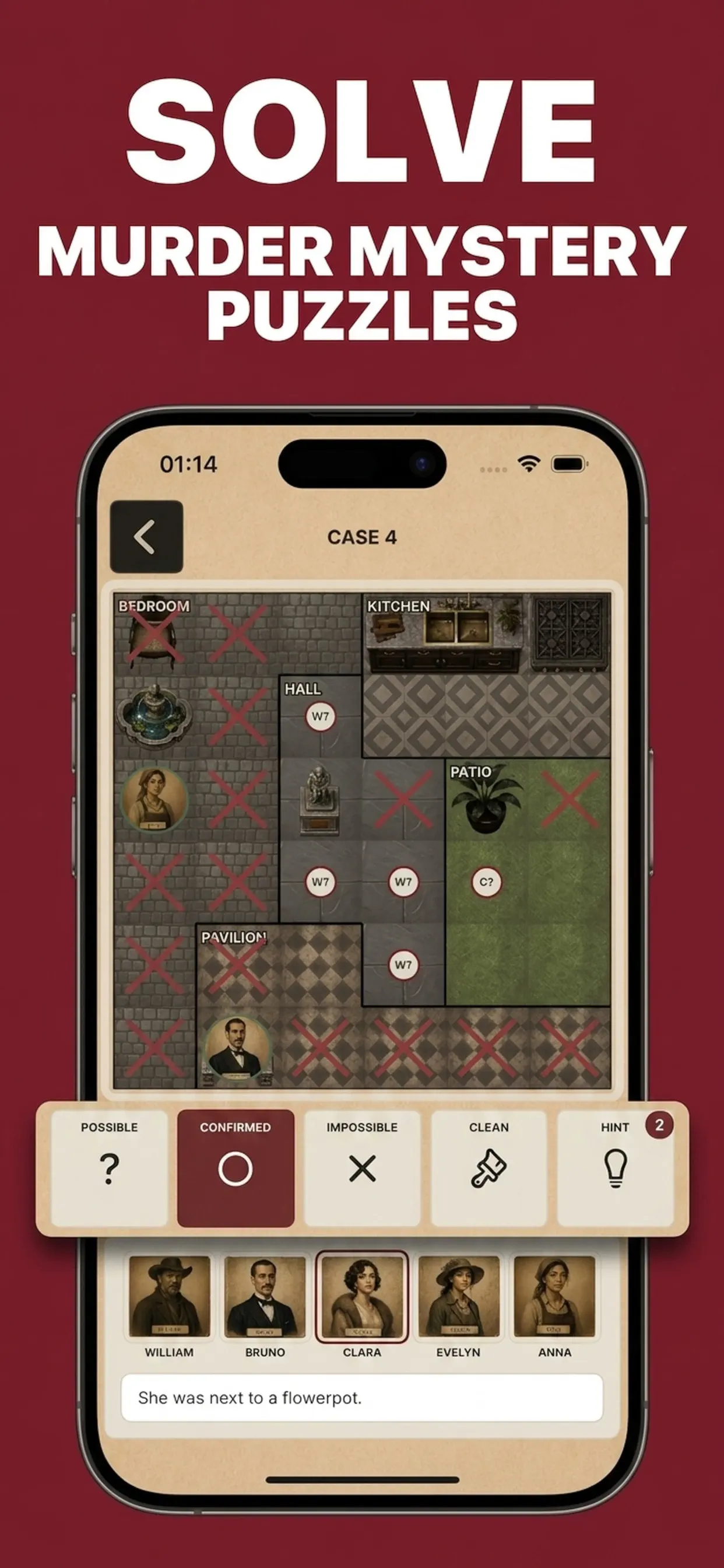
Murder sudoku looks like a mystery scene, but its rules are precise. Once you separate the grid constraint from the narrative clues, the puzzle becomes approachable and systematic.
These are the rules used by Mystery Grid's detective cases.
Rule 1: place each suspect once
Every suspect belongs in one cell of the crime-scene grid. A portrait on the board represents a confirmed position, not a possibility.
You cannot duplicate a suspect or leave a placed suspect in two candidate cells at the end of the solve.
Rule 2: one suspect per row and column
No two suspects may occupy the same row or the same column. This constraint is similar to Sudoku, even though there are no digits or 3×3 number boxes.
When you confirm a position, immediately mark every other usable cell in its row and column as impossible for other suspects.
Rule 3: every clue is true
If a clue says a suspect was in the kitchen, next to an object, or in a specific column, treat that as evidence. The wording limits the candidate cells for that suspect.
Clues work together. A room clue may leave three candidates; a row exclusion created by another suspect can reduce those candidates to one.
Rule 4: the solved grid reveals the crime
Mystery Grid uses the remaining spatial relationship to identify the victim and culprit after every suspect is correctly placed. You do not choose the killer based on story suspicion.
This is why premature guessing is unnecessary: solve the arrangement, and the mystery follows from the completed evidence.
Put the guide into practice
Try it in Mystery Grid
Mystery Grid turns murder mysteries into fair, bite-sized logic puzzles. Read the clues, place each suspect, and reveal the culprit—no guessing, no gore, just deduction.

Common questions
FAQ
Is murder sudoku the same as killer Sudoku?+
No. Killer Sudoku is usually a number puzzle with sum cages. Murder sudoku places suspects using detective clues and row-column constraints.
Can clues contradict each other?+
Not in a fair Mystery Grid case. Apparent contradictions usually mean an earlier possibility was marked as confirmed too soon.