
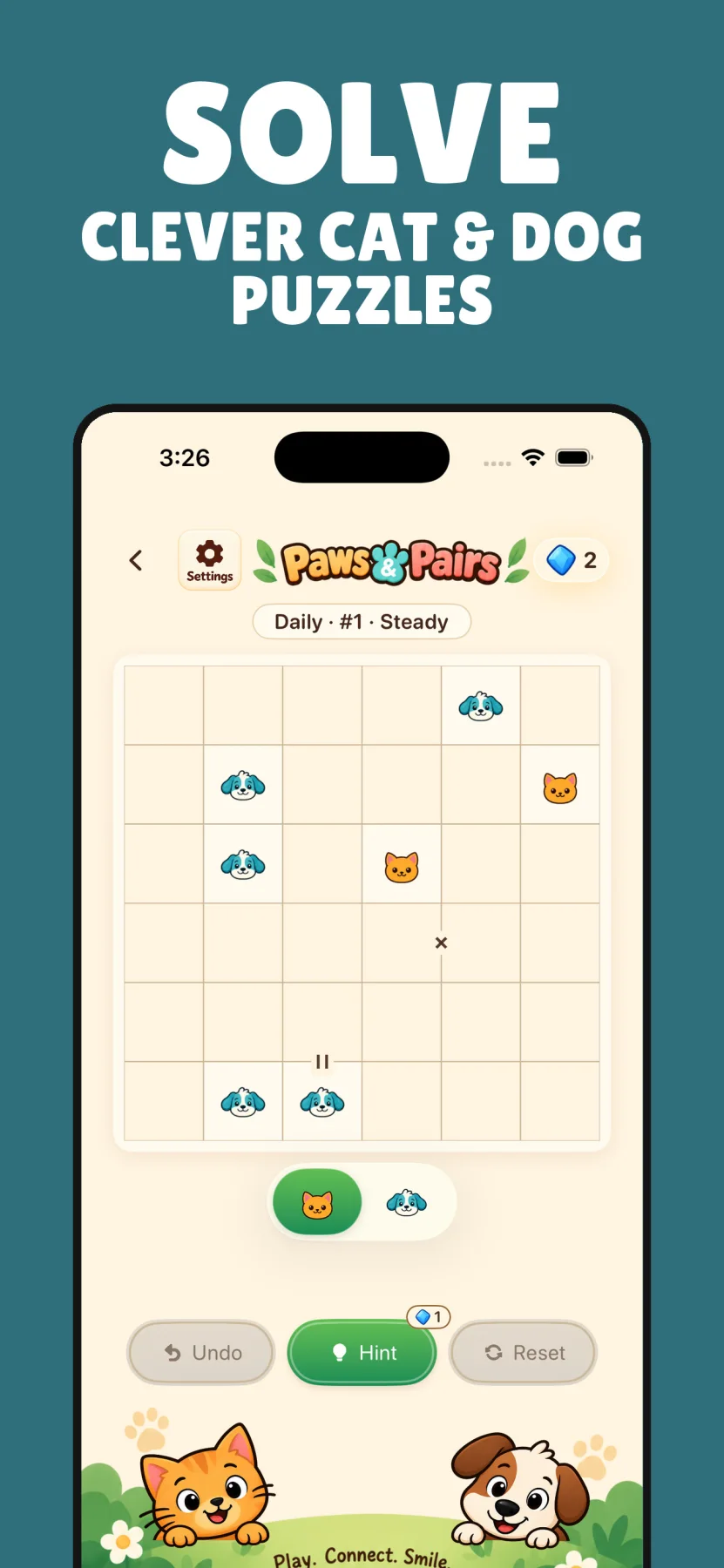
When a binary puzzle feels stuck, the answer is usually not a longer guess. It is a constraint you have not rescanned since the last placement changed a row, column, or linked pair.
The most reliable method is cyclical: scan for triples, count for balance, propagate links, and repeat. Paws & Pairs uses the same loop in its explanatory hint system.
Start with pairs and sandwiches
Find two identical neighboring symbols. Each open cell touching the outer ends of that pair must be the opposite symbol wherever it lies inside the grid.
Next, find matching symbols separated by one empty cell. The middle cannot match them, because that would create a triple. These patterns produce fast, certain placements.
Count before the line looks full
Do not wait until one empty cell remains. On a six-cell line with three cats already placed, every remaining cell is a dog even if the open spaces are far apart.
You can also combine counting with no-triples. If a row still needs two dogs but one candidate cell would create a dog triple, that cell must be a cat.
Propagate same-and-different chains
A known symbol travels immediately through a connector. Longer chains can also be reasoned about: same followed by different means the first and third cells differ; two different links in sequence make the first and third match.
Compare both possible orientations of an unresolved chain against nearby triples and row counts. If one orientation violates a rule, the other is forced; this is deduction, not an arbitrary guess.
Ask for the smallest useful hint
Before revealing a cell, ask which region deserves attention. A focus hint reduces the search area while leaving the actual deduction to you.
In Paws & Pairs, hints can progress from focus to rule to explanation and only then to a reveal. That structure helps you learn the technique instead of merely completing the grid.
Put the guide into practice
Try it in Paws & Pairs
Paws & Pairs is a relaxing Takuzu-style logic puzzle for iOS and Android. Balance cats and dogs, avoid three matching animals in a row, follow same-or-different links, and solve every grid by deduction—never guessing.

Common questions
FAQ
Is testing both possibilities the same as guessing?+
Not when you prove that one possibility breaks a rule. The contradiction logically forces the remaining option.
What should I rescan after a move?+
Start with the affected row and column, then any connector touching the changed cell.