
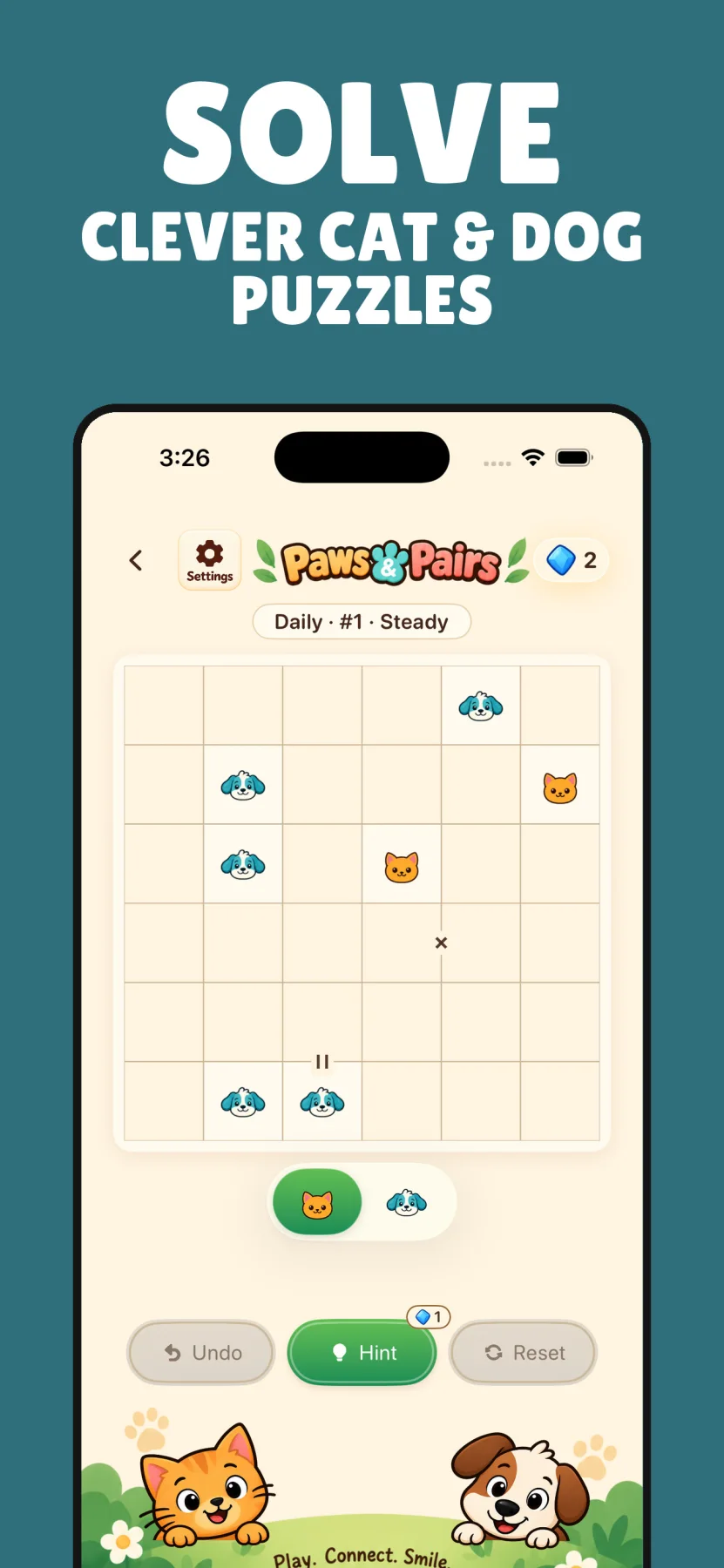
Tango-style puzzles are a connector-based branch of the binary puzzle family. A grid uses two symbols, and the challenge comes from combining global balance with local same-or-different relationships.
Paws & Pairs uses this recognizable structure with cats and dogs. It is an independent game and is not affiliated with LinkedIn or its Tango game.
Balance the two symbols
Each row and column contains the same number of both symbols. On an even-sized grid, the target is always half and half.
Track the count after every connector deduction. A cell resolved locally may complete the quota for an entire row or column and force several more placements.
Prevent three in a row
No three identical symbols can be consecutive horizontally or vertically. This prevents a grid from clustering one symbol even when the final count could still be balanced.
The rule works in both directions: block the end of a pair, or fill the gap between matching symbols with the opposite animal.
Read = and × connectors
An equals-style or double-line connector means its neighboring cells contain the same symbol. An × connector means the symbols differ.
A connector does not tell you which symbol comes first. Use a known neighbor, a no-triples pattern, or a row count to determine the orientation.
Play the pattern in Paws & Pairs
Choose a Journey level for a curated progression, the Steady Daily for one shared challenge each day, or Practice for fresh puzzles at the difficulty you prefer.
Cats and dogs differ by shape rather than color alone, and the hint system can explain which Tango-style rule creates the next forced move.
Put the guide into practice
Try it in Paws & Pairs
Paws & Pairs is a relaxing Takuzu-style logic puzzle for iOS and Android. Balance cats and dogs, avoid three matching animals in a row, follow same-or-different links, and solve every grid by deduction—never guessing.

Common questions
FAQ
Is Tango a type of Takuzu?+
It belongs to the same two-symbol logic family and adds same-or-different connectors to the balance and no-triples rules.
What does × mean in a Tango puzzle?+
The two cells on either side of the × must contain different symbols.